
How Jesse Cole Turned Empty Bleachers Into the Savannah Bananas, a Near-Billion Dollar Phenomenon From Nothing
Jesse Cole loved baseball until baseball stopped loving him back. He rode the pine in summer ball, watched the clock between pitches, and felt the ache every bored fan has felt: this is slow. That sting became a question that would change his life: if I’m bored inside the game, how must it feel outside it?
He took a job running a tiny college summer team that averaged about two hundred fans and had a checking account you could beat with a vending machine purchase. No salary to start. No safety net. Just a clipboard, a dusty ballpark, and a mind buzzing with what-ifs.
Experiments in a half-empty stadium
By day Jesse sold group tickets. By night he devoured Disney, PT Barnum, UFC, WWE, the Grateful Dead, Apple. He ran promotions that sounded like dares: dig-to-China night, a grandma beauty pageant, firing a mascot for taking “BGH” (bear growth hormone). He wasn’t trying to be cute. He was testing a thesis: baseball wasn’t broken; the show around it was.
The result wasn’t overnight success. It was a decade of tinkering. One media story in ten years. A thousand small lessons. Attendance crept up. His reputation—as an imaginative troublemaker who could make empty seats look curious—followed.
Savannah, love, and a lease you could fold into a wallet
He met Emily, a kindred spirit who could see the joy hiding inside logistics. They got engaged on a ballfield. On a celebratory trip to Savannah they wandered into a time-capsule ballpark that felt like baseball’s living room. When the incumbent tenant left after failing to pry a new stadium from the city, Jesse and Emily signed a lease that cost less than a starter car payment. They had a stage. Now they needed a story.
The story didn’t show up. In the first months, they sold two tickets. A launch party drew so few people the venue comped the food out of pity. When the bank account hit fumes, they sold their house, moved into a garage apartment, and slept on a twin air mattress with socks on because the floor was cold. Pain cave, meet dream.
Naming the joke that became the brand
They asked the community to name the team. A 62-year-old nurse sent in “Bananas.” It sounded ridiculous. It also sounded unforgettable. Savannah Bananas stuck. They invested what little cash they had into a real logo because Jesse knew this was an identity play, not a hobby. Years later, that mark would move mountains of merch and light up ballparks across the country.
And he layered the gag with heart. A senior dance squad called the Nanas. Male cheerleaders called the Man-Nanas. Silly? Absolutely. Sticky? Completely. Different is memorable; normal dissolves.
Fan First, or don’t bother
Jesse mapped the fan journey with the fanaticism most people reserve for code reviews. He watched security-cam footage after games to see when people got up, where lines formed, which moments lost energy. He treated a two-hour night like a laboratory.
He chose hills to die on.
• One price, no gotchas. If the ticket said 25 dollars, the fan paid 25 dollars. The team ate the taxes.
• Two hours, home for bedtime. Families mattered more than conventions.
• Food as welcome, not weapon. All-you-can-eat nights turned the concession stand from a tollbooth into a hug.
It sounded small. It felt huge. Words say fan-first. Actions prove it.
Banana Ball: the rules are the product
Baseball is sacred, but boredom is not. Jesse rewired the format to make time a feature, not a tax.
• Two-hour cap. The clock is a character in the show.
• Fans can catch a foul for an out. The crowd is part of the game.
• No bunting. Play bold or sit down.
• On ball four, the hitter sprints while the defense must touch the ball through the infield before a tag. Hustle is entertainment.
It wasn’t a prank. It was product design under stadium lights, built for pace, laughs, and goosebumps.
The idea muscle, trained daily
Starting in 2016, Jesse forced himself to write ten new ideas a day. Most were bad. The point was reps. When six good ones show up in a hundred, you change an inning. When sixty show up in a year, you change a sport.
He also changed his team-building filter. Skills mattered, but one trait mattered more: are you down? Down to try unproven things. Down to defend fragile ideas. Down to make a hot-dog run if that’s what delight requires.
From gimmick to gospel
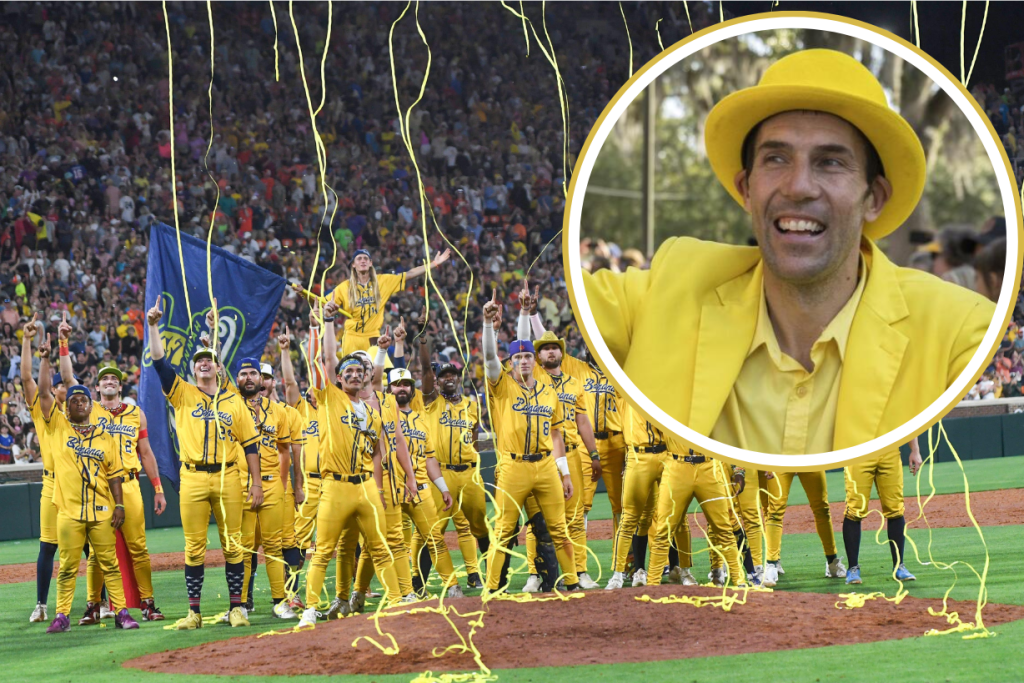
The internet noticed. Clips traveled. Dances spread. Characters formed. A family show with baseball’s bones and vaudeville’s heart turned into a touring circus of joy. Tickets became a lottery. The waiting list swelled into the millions. Merch turned strangers into street-teamers. Big-league parks opened their doors. A small summer outfit became a year-round phenomenon.
Behind the bright yellow tuxedo was discipline:
• Measure what people actually do, not what they say they want.
• Make a promise simple enough for a child to repeat.
• Spend real money signaling your values.
• Institutionalize weird. If it’s remarkable, make it a rule.
The bus replaces the money button
Some businesses have a money button. Click send, revenue lands. This wasn’t that. The Bananas’ money comes on a bus, at 5 a.m., with a load-in checklist and a city that has never seen this show in person.
Live events are messy, human, and gloriously AI-proof. You can’t download a foul ball into your hands. You can’t stream the way a stadium laughs in unison when a hitter moonwalks to first. You have to be there.
That scarcity is the moat. The bus is the bridge.
The compounding edge of unreasonable hospitality
There’s a restaurant parable Jesse would appreciate: a guest longs for a New York street hot dog at a Michelin-star dining room. The owner leaves, buys a dog, plates it like art, and changes a life. That’s unreasonable hospitality. It costs more today and earns interest forever.
Jesse codified that into the Bananas:
• Pay the taxes.
• Answer the emails like a neighbor.
• Choreograph surprise.
• Treat mistakes as stages to astonish.
String enough of those beads together and you don’t just build revenue—you build lore.
What this teaches anyone starting from nothing
The Savannah Bananas weren’t an overnight success; they were a thousand nights of choosing delight over default. You don’t need permission to do that. You do need conviction.
Steal Jesse’s playbook and bend it to your world:
• Write ten ideas every day for sixty days. Terrible is acceptable; average is not.
• Identify one friction that insults your customer. Remove it at your cost.
• Make a rule that scares you because it’s so fan-first. Announce it, then defend it.
• Design for a two-hour attention span, even if you sell software, not seats.
• Hire for downness. Train for showmanship.
The bow on the banana
Jesse started with an empty stadium and a stubborn belief that joy, packaged well, scales. He slept on an air mattress and bet the house on a goofy name. He rewrote rules, overpaid for a logo, and undercharged for trust. He turned fans into cast members, games into memories, and a local novelty into a national tour.
Call it circus. Call it sport. Call it banana-flavored lightning in a bottle. Whatever you call it, the lesson is simple and hard: if you obsess over delight like it’s your whole job, one day it will be—and the world will line up to watch you do it.